Rigidon Mono: Where Typewriter Grit Meets High-Fashion Serifs
You’ve seen the monospace revival everywhere—coding terminals, retro tech aesthetics, and that distinct, mechanical rhythm in modern web design. But most of these typefaces lean into a sterile, purely functional vibe. Rigidon Mono breaks that pattern entirely. It takes the fixed-width structure we associate with typewriters and early computing and injects it with the sharp, sophisticated authority of a high-fashion Roman serif. The result is a premium font that feels both intellectually rigorous and visually striking.
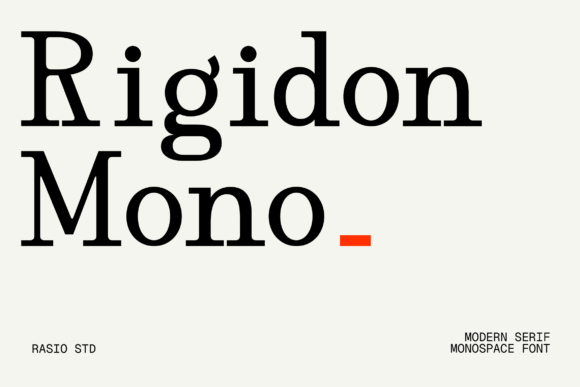
This isn't just a technical script with serifs glued on. The design philosophy is clear in its details: stark, rigid vertical stems give it an unshakable presence. The uniform letter envelopes ensure every character occupies its space with deliberate precision. Those sharp, hard-edged horizontal serif anchors aren't decorative afterthoughts; they command attention and provide an architectural foundation that typical monospace fonts lack. It’s this fusion—raw, mechanical precision meeting refined editorial elegance—that makes Rigidon Mono such a compelling creative font.
A Typeface Built for Contrast and Authority
The personality of Rigidon Mono is one of controlled tension. It carries the intellectual weight of a serif font but delivers it with the blunt, grid-friendly honesty of a monospace layout. This creates an immediate visual contrast. Imagine a minimalist real estate layout where property specs and headlines need to feel both clean and substantial. Rigidon Mono provides that structural clarity without looking like a spreadsheet. Or consider a progressive magazine design heading for a feature on brutalist architecture or industrial design; this typeface mirrors the subject’s ethos perfectly.
Its appeal lies in its versatility within specific, high-impact contexts. It’s a display font at heart, built to make statements in headlines, logos, and pull quotes. But because of its monospace backbone, it handles blocks of short-form text—like captions, technical specifications, or interface labels—with surprising coherence. For designers working on brand identity projects that need to convey innovation, precision, and a touch of avant-garde sophistication, Rigidon Mono offers a distinct voice that avoids the overused paths of handwritten fonts or generic sans serif font families.
Practical Applications: From Streetwear to Social Grids
Where does Rigidon Mono truly shine? Its strengths are most apparent in projects that value visual hierarchy and a strong editorial edge. Let’s break down some realistic scenarios.
Creative & Branding: For cutting-edge streetwear lookbooks or alternative tech lifestyle blogs, this font sets a definitive tone. Use it for brand logos, collection titles, and key messaging in lookbook layouts. Its rigid structure communicates a no-nonsense, design-forward attitude. It pairs interestingly with a clean, geometric sans serif font for body text, creating a dynamic hierarchy where the serif monospace demands focus and the sans serif provides breathing room.
Marketing & Digital: In social media graphics, especially for platforms like Instagram or LinkedIn where feed stops are crucial, Rigidon Mono headlines can halt the scroll. Its sharp serifs and uniform spacing make it highly legible even at smaller sizes in graphics. For modern coding terminal backgrounds or developer portfolio sites, it bridges the gap between functional code display and aesthetic design, making the technical feel intentional and styled. As a web design asset, it works brilliantly for hero section headings, navigation menus on creative agency sites, or as a standout font for pricing tables and feature lists in SaaS marketing.
Publishing & Editorial: This is where its editorial design roots come alive. Think magazine section openers, chapter titles in a design-focused book, or headers for a premium PDF report. The font’s inherent authority lends weight to the content, suggesting seriousness and curation. It’s a fantastic choice for packaging design for high-end, minimalist products—think artisanal spirits, boutique electronics, or specialty stationery—where every typographic detail contributes to the unboxing experience.
Making It Work: Pairing, Readability, and Licensing
Adopting a strong typeface like Rigidon Mono requires a thoughtful approach. First, evaluate the fit. Does your project call for this blend of technical precision and serif elegance? It’s less suited for long-form reading in a novel or a children’s website, but perfect for projects aiming for a modern typography aesthetic with a conceptual edge.
Font pairing is critical. Because Rigidon Mono has such a strong character, balance it with something simpler. A neutral sans serif font like a grotesque or neo-grotesque style often works well for body copy, letting the monospace serif command the headlines. Avoid pairing it with another highly decorative script font or a very ornate serif, as this can create visual clutter.
Test its readability in context. While it’s designed for clarity, the monospace spacing can feel wide in dense paragraphs. Use it primarily for short bursts of text: headlines, subheads, buttons, quotes, and labels. Its strength is in display settings and controlled data presentation. Review the font package to see what’s included—does it have multiple weights, italics, or extended character sets for multilingual support? This affects its utility across different design assets.
Finally, understand the licensing. As a commercial font, ensure the license covers your intended use—whether for a single client project, unlimited digital ads, or embedded in a mobile app. Proper licensing protects your work and supports the type designers who craft these essential tools.
Rigidon Mono isn’t just another font; it’s a strategic design asset. By combining the raw framework of a monospace with the refined details of a serif, it offers designers, entrepreneurs, and creators a powerful way to inject intellectual contrast and architectural authority into their visual communications. When used with intention, it can elevate a brand identity, sharpen an editorial layout, and make a digital interface feel both precise and profoundly stylish.