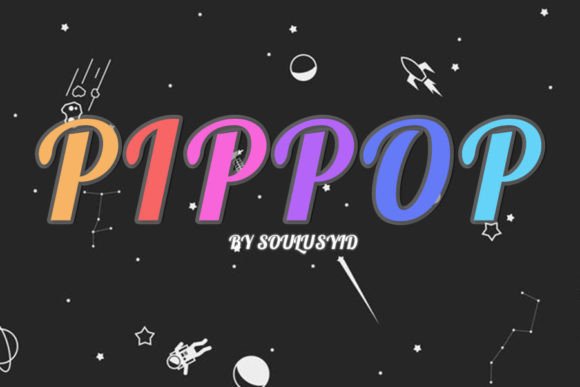
Pippop: The Display Font That Demands Attention
In a world saturated with clean sans-serifs and predictable serifs, sometimes a design needs a spark—something that doesn’t just sit there but actively participates in the visual conversation. This is exactly where Pippop enters the scene. It is a bold, eye-catching display font designed specifically for headings, titles, and those short blocks of text that need to make an immediate impact. Characterized by unique, playful letterforms and exaggerated details, Pippop is less about quiet readability and more about visual volume. It is a typeface that refuses to blend in, offering a distinct personality that can transform a standard layout into something memorable.
As a designer or business owner, understanding the nature of a premium font like Pippop is crucial. You wouldn't use a script font for a legal document, just as you wouldn't use a standard body font for a billboard. Pippop falls firmly into the category of a creative font built for impact. Its visual characteristics often lean towards a modern, somewhat whimsical aesthetic. The letterforms might feature irregular baselines, varying stroke widths, or quirky terminals that give the text a sense of movement. This isn't just typography; it's personality rendered in vector form. When you install Pippop, you aren't just adding a style to your library; you are adding a voice that speaks with energy and confidence.
Strategic Applications: Where Pippop Shines
The strength of a display font lies in its versatility across different mediums, provided it is used with intent. Pippop is incredibly effective in brand identity work, particularly for brands that want to position themselves as approachable, energetic, or creative. Imagine a children’s toy brand, a quirky coffee shop, or a modern podcast. Using Pippop in their logo design can instantly communicate that the brand is fun and distinct. Because the letterforms are exaggerated, they create a strong silhouette that aids in brand recognition. However, this boldness requires careful handling. It is best reserved for headlines and logos, leaving the heavy lifting of body text to a more neutral sans serif font or serif font.
Beyond logos, consider the power of Pippop in packaging design. On a crowded shelf, a consumer’s eye is drawn to contrast and novelty. A product name set in Pippop can jump off the box, creating a tactile, playful feel even before the customer touches the item. This is particularly true for artisanal goods, snacks, or lifestyle products where the packaging needs to reflect the joy of the product inside. Similarly, in editorial design, such as magazine covers or chapter headers in a book, Pippop can break the monotony of standard text, guiding the reader's eye and establishing a rhythmic visual hierarchy.
Digital spaces also benefit significantly from this typeface. In web design, a hero section needs to grab attention within seconds. A heading set in Pippop can set the tone for the entire user experience, signaling that the site is modern and user-friendly. Likewise, social media graphics are often viewed on small screens where nuance is lost. Pippop’s bold details ensure that your message remains legible and impactful even as a thumbnail. Whether it is an Instagram story, a YouTube thumbnail, or a Pinterest pin, this font helps content creators cut through the noise.
Mastering the Pairing and Hierarchy
Using a creative font effectively requires a strategy for font pairing. Because Pippop has such a strong personality, it can easily overwhelm a design if not balanced correctly. The golden rule here is contrast. You generally want to avoid pairing Pippop with another decorative or handwritten font, as this creates visual clutter. Instead, let Pippop be the star of the show by pairing it with a quiet, neutral companion.
A clean sans serif font is often the perfect partner. The simplicity of the sans serif allows the details of Pippop to breathe. For example, if you are designing a poster for a music festival, you might use Pippop for the band names to convey energy, and a geometric sans serif for the dates and location to ensure logistical information is easy to scan. Alternatively, pairing Pippop with a classic serif font can create a sophisticated yet playful juxtaposition, blending traditional elegance with modern flair. This approach works well for boutique branding or lifestyle blogs where you want to appear grounded but not boring.
When evaluating your project fit, consider the visual hierarchy. Pippop should almost exclusively occupy the top of the hierarchy—titles, headers, and pull quotes. It is not designed for long-form reading. If you force Pippop into a paragraph of 12-point text, you will compromise readability and frustrate your audience. Instead, use it to draw the eye in, and then hand the reader off to a legible body typeface. This transition guides the reader naturally from the headline to the content, improving the overall flow of the design.
Practical Considerations for Professionals
Before integrating Pippop into your next project, it is wise to perform a few practical checks. First, review the included styles. Many premium fonts come with variations—such as bold, italic, or outline versions—that can expand your creative toolkit. Knowing exactly what glyphs are available (such as special characters or ligatures) can help you avoid headaches during the layout phase.
Second, always test for readability in context. A font that looks great on a high-resolution monitor might lose its charm when printed on textured paper or viewed on a low-quality mobile screen. Zoom out and view your design at a thumbnail size to ensure the "exaggerated details" still read as letters and not just abstract shapes. This is a critical step in web design and packaging design alike.
Finally, understand the licensing. Most high-quality design assets, including fonts like Pippop, come with specific commercial licenses. If you are a freelancer creating a logo for a client, or a business owner using the font on merchandise, ensure your license covers that specific usage. Respecting these boundaries ensures that you can use the font legally and ethically across all your marketing channels.
Ultimately, Pippop is a tool for expression. It is a modern typography choice for those who aren't afraid to be seen. By understanding its strengths in logo design, editorial design, and social media graphics, and by pairing it with the right companions, you can leverage this typeface to build a brand identity that is as dynamic and engaging as the audience you are trying to reach. It is not just a font; it is a design statement.